Tuesday, January 17, 2023
I'm finally on Spotify! (a.k.a. GoTriple platform podcast)


Tuesday, September 14, 2021
Still alive (and an interview)
I know, I know, there's nothing worse than a neglected blog...
Just a quick update on what I do these days, is available on the Operas EU Blog. And yes, it's still related to Pundit!
Read on the @OPERASEU blog how @lucadex from #TRIPLE partner @netseven_it got into #OpenScience and what wine tasting has to do with the next work package leader meeting: https://t.co/aWL2MAA0xD#Discover #Connect #Collaborate #SSH #Pundit #annotation #GreatTeam pic.twitter.com/so8W35Odse
— TripleEU (@TripleEU) September 3, 2021
Saturday, September 24, 2016
Going to Bratislava!
At the end we made it! Pundit has been selected as one of the 16 finalists of the Innovation Radar Prize 2016!
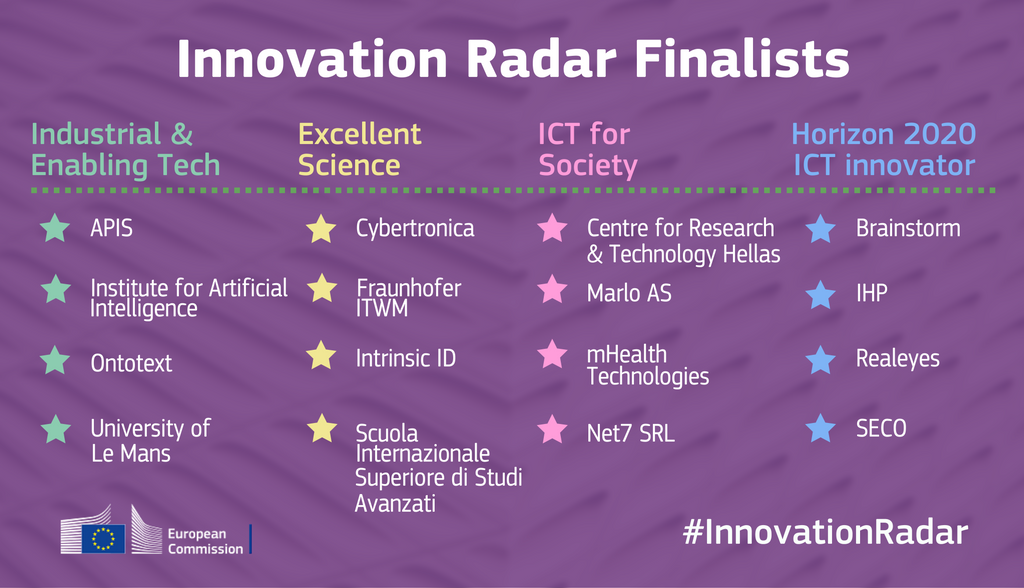 My colleagues and I are about to leave for Bratislava, where we are going to pitch Pundit. Needless to say, we are very excited and we hope to be able to present our product to the widest possible audience. We are also demoing Pundit on Tuesday 27th, on the Innovation Booth, from 11 AM to 1 PM.
Besides, we are also very interested to participate to the ICT Proposers' Day 2016 where we hope to have a lot of chances to network with people from all over Europe. So, if you happen to be in Bratislava on the 26th and the 27th of September, don't hesitate to drop me an email to arrange a meeting.
Fingers crossed for Pundit!
Besides, we are also very interested to participate to the ICT Proposers' Day 2016 where we hope to have a lot of chances to network with people from all over Europe. So, if you happen to be in Bratislava on the 26th and the 27th of September, don't hesitate to drop me an email to arrange a meeting.
Fingers crossed for Pundit!
Friday, August 05, 2016
Pundit selected for the Innovation Radar Prize 2016!
Just a very quick post (before leaving for the Summer vacation...) to report that Pundit was selected for the Innovation Radar Prize 2016, a European Commission initiative to identify high potential innovations and innovators in EU-funded projects.
Our project is one of the 40 short-listed EU-funded innovators. Now everybody is invited to vote, until August 31st, the top 16 innovators, who will compete in the Innovation Radar final, at the ICT proposers' day in Bratislava on 26 September 2016.
So, if you happen to see this post... please give your vote to Pundit here.

Our project is one of the 40 short-listed EU-funded innovators. Now everybody is invited to vote, until August 31st, the top 16 innovators, who will compete in the Innovation Radar final, at the ICT proposers' day in Bratislava on 26 September 2016.
So, if you happen to see this post... please give your vote to Pundit here.

Monday, June 27, 2016
The context for web annotation
As I wrote a few days ago, the final review of the StoM project was held on Tuesday June 21st. All went more than fine as the final assessment of the work states, for the quality of the results, that "…the actions have been performed very well and the project has achieved excellent progress"!
I'm very happy of course: the preparation of the review was a hard work. I prepared 5 presentations, most of which related to the work done in the project. One of them was the "Presentation of context: Web Annotations (& Pundit) during the StoM Project (May 2014 – Apr. 2016)".
The purpose was to introduce, at the beginning of the review, the context for the two main StoM products, the event management SaaS platform EventPlace and the Pundit Annotation System.
While my friend George Ioannidis introduced how the Event Industry is evolving and needs new tools to better engage attendees and exhibitors, I presented what has happened in the two years of the project in the context of web annotation. My talk was based on the presentation attached below.
Enjoy (and don't hesitate to provide feedbacks)!
I'm very happy of course: the preparation of the review was a hard work. I prepared 5 presentations, most of which related to the work done in the project. One of them was the "Presentation of context: Web Annotations (& Pundit) during the StoM Project (May 2014 – Apr. 2016)".
The purpose was to introduce, at the beginning of the review, the context for the two main StoM products, the event management SaaS platform EventPlace and the Pundit Annotation System.
While my friend George Ioannidis introduced how the Event Industry is evolving and needs new tools to better engage attendees and exhibitors, I presented what has happened in the two years of the project in the context of web annotation. My talk was based on the presentation attached below.
Enjoy (and don't hesitate to provide feedbacks)!
Saturday, June 18, 2016
Working on StoM final review
I'm preparing the slides for the StoM project final review, that will take place next Tuesday, June 21st, in Bruxelles.
Still a lot to adjust today and tomorrow, before taking the plane to Belgium on Monday morning. It was my first European project as a coordinator and despite some (inevitable) problems every now and then, I'm quite happy of this experience.
I'm especially happy of how, thanks also to StoM, Pundit, our web annotation platform, came out.
By the way, we made also some very cool videos to showcase Pundit. Have a look, download Pundit and... start annotating the web!
Still a lot to adjust today and tomorrow, before taking the plane to Belgium on Monday morning. It was my first European project as a coordinator and despite some (inevitable) problems every now and then, I'm quite happy of this experience.
I'm especially happy of how, thanks also to StoM, Pundit, our web annotation platform, came out.
By the way, we made also some very cool videos to showcase Pundit. Have a look, download Pundit and... start annotating the web!
Saturday, December 05, 2015
Presentation at Italian Drupal Day
I'm just back from Bologna, where I attended with my colleagues the Italian Drupal Day conference. We at Net7 are working on several Drupal based projects (the latest I've managed being the website of Scuola Sant'Anna, one of the most prestigious universities in Italy).
We decided to do a presentation on the Innolabsplus.eu project, in which we exploited the semantic API of Dandelion to completely automatise the work of an editorial team. Software services fetch articles from more than 40 web sites (in Italian, English and French) and analyse their texts using Dandelion's Named Entity Extraction and Automatic Classification services. If the article matches with the topics of interest of the portal, it is automatically published, if not it gets discarded.
The site has been in production for several months now, publishing hundreds and hundreds of selected contents, in three languages, without a hiccup and without any manual intervention.
The Drupal Day slides follow (in Italian). Enjoy!
We decided to do a presentation on the Innolabsplus.eu project, in which we exploited the semantic API of Dandelion to completely automatise the work of an editorial team. Software services fetch articles from more than 40 web sites (in Italian, English and French) and analyse their texts using Dandelion's Named Entity Extraction and Automatic Classification services. If the article matches with the topics of interest of the portal, it is automatically published, if not it gets discarded.
The site has been in production for several months now, publishing hundreds and hundreds of selected contents, in three languages, without a hiccup and without any manual intervention.
The Drupal Day slides follow (in Italian). Enjoy!
Subscribe to:
Posts (Atom)