Showing posts with label Semantic Web. Show all posts

Tuesday, September 14, 2021

Still alive (and an interview)

 I know, I know, there's nothing worse than a neglected blog...

Just a quick update on what I do these days, is available on the Operas EU Blog. And yes, it's still related to Pundit!


Saturday, September 24, 2016

Going to Bratislava!

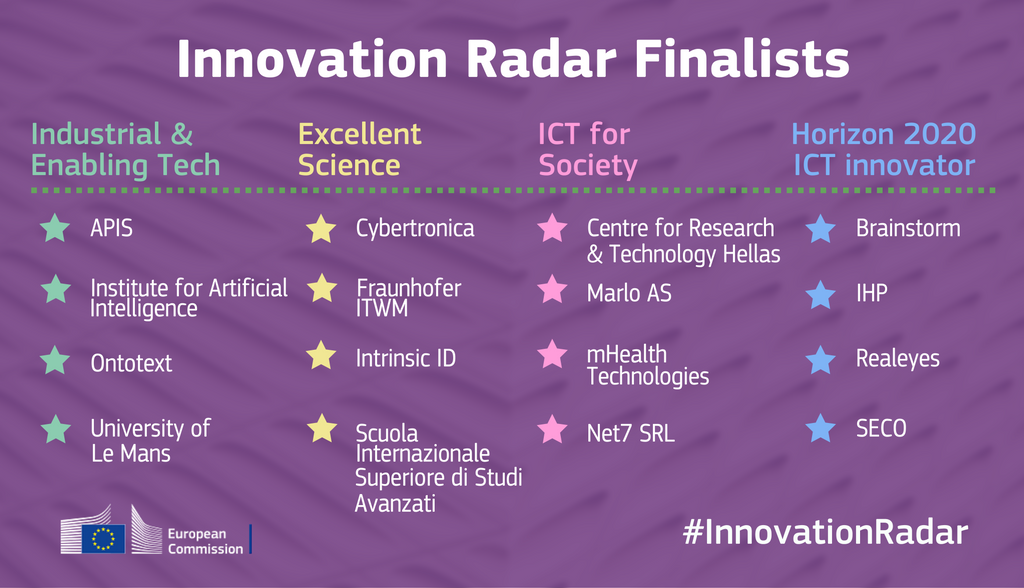
At the end we made it! Pundit has been selected as one of the 16 finalists of the Innovation Radar Prize 2016!
My colleagues and I are about to leave for Bratislava, where we are going to pitch Pundit. Needless to say, we are very excited and we hope to be able to present our product to the widest possible audience. We are also demoing Pundit on Tuesday 27th, on the Innovation Booth, from 11 AM to 1 PM.

Besides, we are also very interested to participate to the ICT Proposers' Day 2016 where we hope to have a lot of chances to network with people from all over Europe. So, if you happen to be in Bratislava on the 26th and the 27th of September, don't hesitate to drop me an email to arrange a meeting.

Fingers crossed for Pundit!

Monday, June 27, 2016

The context for web annotation

As I wrote a few days ago, the final review of the StoM project was held on Tuesday June 21st. All went more than fine as the final assessment of the work states, for the quality of the results, that "…the actions have been performed very well and the project has achieved excellent progress"!

I'm very happy of course: the preparation of the review was a hard work. I prepared 5 presentations, most of which related to the work done in the project. One of them was the "Presentation of context: Web Annotations (& Pundit) during the StoM Project (May 2014 – Apr. 2016)".

The purpose was to introduce, at the beginning of the review, the context for the two main StoM products, the event management SaaS platform EventPlace and the Pundit Annotation System.

While my friend George Ioannidis introduced how the Event Industry is evolving and needs new tools to better engage attendees and exhibitors, I presented what has happened in the two years of the project in the context of web annotation. My talk was based on the presentation attached below.

Enjoy (and don't hesitate to provide feedbacks)!


Saturday, December 05, 2015

Presentation at Italian Drupal Day

I'm just back from Bologna, where I attended with my colleagues the Italian Drupal Day conference. We at Net7 are working on several Drupal based projects (the latest I've managed being the website of Scuola Sant'Anna, one of the most prestigious universities in Italy).

We decided to do a presentation on the Innolabsplus.eu project, in which we exploited the semantic API of Dandelion to completely automatise the work of an editorial team. Software services fetch articles from more than 40 web sites (in Italian, English and French) and analyse their texts using Dandelion's Named Entity Extraction and Automatic Classification services. If the article matches with the topics of interest of the portal, it is automatically published, if not it gets discarded.

The site has been in production for several months now, publishing hundreds and hundreds of selected contents, in three languages, without a hiccup and without any manual intervention.

The Drupal Day slides follow (in Italian). Enjoy!


Wednesday, August 05, 2015

My Nerdie Bookshelf - "Linked Data - Structured data on the web" by David Wood, Marsha Zaidman, Luke Ruth and Michael Hausenblas

This book has been a bit of a disappointment to me, the first one I had from Manning Publications.

Despite being published in 2014 you have the impression that the information provided here are stale. Only in the final chapter ("The evolving Web") a comprehensive, well written and updated viewpoint on Linked Data (and the Semantic Web) is provided, although in concise form.

The foreword by Tim Berners-Lee and the collaboration with Michael Hausenblas lured me to blind purchase the book. In particular I was looking for insights in what, in my viewpoint, is a powerful use case for Linked Data which hasn't been addressed enough, that is Semantic Enterprise Data Integration, hoping to get, as it is common for Manning books, a lot of advanced technical information. In particular I was, and still am, looking for technical advice, integration patterns and product reviews that can guide me in using Semantics to effectively interconnect enterprise data silos.

The book on the other hand revolves around a different perspective, those of a data publisher, with little (if any) notion of the technology behind Linked Data. It presents therefore all the basic concepts at a quite simple level.
This is of course a legit editorial choice but what annoyed me the most was the fact that the information provided are often outdated. No mention on JSON-LD or to the Linked Data Platform principles; CKAN, a widely used platform for creating open data repositories, is just cited but only in connection to the DataHub site. Moreover, the motivations, advantages, pros and cons of working on Linked Data are presented in a very basic, if not superficial, way.

The mention of Callimachus, the "Linked Data application server" created by the authors, left me unimpressed as well, even if it is correct to say that it has been used in interesting projects.

I must admit that I am biased and might sound arrogant (sorry if this is the case): at the end of the day I've been working on these topics for 5 years. The fact is that this book could have been appealing to beginners if only could present more up-to-date information and more detailed use cases. Linked Data looks like it was written in 2010: it could make sense to publish it in 2011, not, as it was the case, in 2014.

Monday, April 27, 2015

There’s Semantics in this Web

I was asked by Dr. Serena Pezzini of the CTL department of the Scuola Normale Superiore of Pisa to do a presentation on the Semantic Web on April 16th (beside there’s a photo of me taken at the event). Slides, in Italian, are available on SlideShare: the preparation has been a quite interesting process, so I thought to share it in this blog here, this time in English.

This presentation for me was in fact like opening up the legendary Pandora’s Box. It ignited a reflection about what we as a company do regarding the Semantic Web. Net7 in fact always characterizes itself as a “Semantic Web Company".

At about the same time I was contacted both by CTL and by a partner company to talk about this subject. On the one hand CTL expected suggestions and stimuli to use Semantic Web technologies in their work on the Digital Humanities field. The partner company was looking for professional training on these topics.

For 5 seconds I went into autopilot mode and started to think about explaining the Semantic Web in the standard fashion (RDF, ontologies, triple stores, SPARQL, RDFS, OWL, well, you got the idea…). Then three questions sprang to my mind...

Do these persons really need this kind of information? Are they going to really use all of this on their daily job?

The second question is a bit discomforting: do we at Net7 really use completely and especially consciously the whole of the Semantic Web technologies?

The third is even more serious: what’s the current state of the art of the Semantic Web? Is it still an important technology, with practical uses even for middle/low-sized projects, or should it stay confined in the Empyrean of research and huge knowledge management initiatives?

So, it was really important for me to do a presentation with the attempt to find answers to these questions, to present topics that could be of interest and useful to the audience and at the same time to put in a new perspective my knowledge on the field.

The presentation therefore came out as a reflection on the possible uses and advantages of "Semantics in the web", first and foremost for me, in order to reorder my mind, with the hope that it can be useful for others as well. I tried therefore to take a step back, hopefully to progress further in perspective.

For its preparation I read a great deal of material (see bibliography at the end) and was heavily influenced by the presentations and articles of Jim Hendler (not to mention the fantastic book “Semantic Web for the working ontologist” that he co-authored). So, even if you won’t read these lines, thank you very much Dr. Hendler for your insightful thoughts!

Coming back to my presentation, it is not a case that I used the concept “Semantics in the Web” and not “Semantic Web” in the title. Semantics in fact, in the light of all the readings that I did, seems to me more important than the technology behind it.

I started the presentation with a small historical digression, from the very first vision of the World Wide Web in the Tim Berners-Lee's 1989 original proposal, up to the seminal 2001 article on Scientific American, where Berners-Lee, James Hendler and Ora Lassila presented the Semantic Web.

I continued by explaining the key concepts of the Semantic Web, which served to prove how Semantics, despite the Semantic Web vocal critics, can still count huge success stories in the web of today.

The funny thing is that the Semantic Web’s vision didn’t exactly materialize as expected by its inventors. On the one hand is fundamental to comprehend how things in web history just happens through serendipity. On the other is crucial to have always in mind the Jim Hendler’s motto “a little semantics goes a long way”. Indeed just a small portion of the Semantic Web “pyramid” (see slide number 42 in my presentation, taken from a Jim Hendler’s keynote) finds a recurring use, while the rest (inferences and the most sophisticated OWL constructs included) has still a limited diffusion or is just relegated in high-end research initiatives.

So the Semantic Web hasn’t failed but materialized a bit differently than expected. One therefore should really think to Semantics first, that is to exploit the knowledge that can be extracted from documents, linked data repositories, machine readable annotations in web pages (SEO metadata included) before worrying about the orthodox application of the complete stack of Semantic Web technologies.

The Semantic Web is on the other hand a still promising and on certain aspects undiscovered territory. While I don’t honestly see it as a key technology to power web portals (there are plenty of more mature technologies, even open source, - think of Drupal or Django - that fit better this purpose) the idea of managing information through graph makes a lot of sense in several areas, including:
  • knowledge management with highly interconnected data (think of Social Network relationships). Here the capacity of triple stores to handle big graph data will really make the difference, especially if an open source product can be used for this purpose (recently we @ Net7 have bet on Blazegraph and while we have been quite satisfied until now, it must be also said that our graphs are not exactly “that big”). There is no doubt in fact that solid open source products are fundamental to skyrocket the use of specific technologies and software architectures (think of LAMP).
  • extraction of structured data from text: a great classic Semantic Web use case indeed
  • linking independent repositories of information, implemented with traditional technologies in multiple legacy systems (another Semantic Web classic).
  • raw data management and dissemination.
The latter is something that we @ Net7 would really like to explore in great details in the near future. The idea arises from a contact that we have with a local medical research centre: we noticed that very often their management of data acquired through sensors is untidy. This leads to data loss and corruption. Moreover, raw data after the medical research is over, gets dismissed. On the other hand if this data could be:
  • formally described in great detail
  • openly distributed, after a specific anonymizing process in order to remove “sensible information” from it
it might open the door for its reuse. This way scientists from all over the world can take this data and exploit it in their research, increasing the dimension of their data sets and consequently improving the probability ratio of their experiments. This isn’t something new indeed but it will become more and more relevant in the near future since the European Commission is fostering Open Access to research data in the Horizon 2020 projects.

I concluded my slides by also noticing that Semantics is becoming more and more a commodity, offered through specialized cloud services. Named Entity Recognition SaaS offerings, SpazioDati’s DataTXT and AlchemyAPI included, are a consolidated reality. Cloud Machine Learning services are becoming mainstream (see in this regard this insightful article on ZDNet). Developers therefore can enjoy “a little semantics” in their application, without embracing the Semantic Web in full. As Jim Hendler says in fact… a little semantics goes a long way!


Bibliography


Tuesday, February 17, 2015

“The importance of being semantic”: Annotations vs Semantic Annotations

The focal point of many Net7’s projects is on semantic annotations. What does it really mean and why the term semantic is so important in this context?

Annotations can be simply seen as “attaching data to some other piece of data”, eg documents; the advantage of a semantic annotation is to have this data formally defined and machine-understandable. This offers better possibility for search, reuse and exploitations of the annotations performed by users.

In [Oren 2006] a formal definition of annotation has been proposed. Simply speaking it consists of a tuple with:
  • A. the information that is annotated inside the text
  • B. the annotation itself
  • C. a predicate, that establishes a relationship amongst the two points above
  • D. the context in which the annotation has been made (who made it, when, its reliability, a possible limit for its validity, etc).
This holds true for all kinds of annotation, including handwritten notes beside paper documents.

A simple definition of semantic annotation is proposed in [Kiryakov 2004], where it is presented a vision by which “...named entities constitute an important part of the semantics of the document they are mentioned in… In a nutshell, semantic annotation is about assigning to the entities in text links to their semantic descriptions”.

A very effective definition of semantic annotation can be found in the Ontotext web site: “Annotation, or tagging, is about attaching names, attributes, comments, descriptions, etc. to a document or to a selected part in a text. It provides additional information (metadata) about an existing piece of data. … Semantic Annotation helps to bridge the ambiguity of the natural language when expressing notions and their computational representation in a formal language. By telling a computer how data items are related and how these relations can be evaluated automatically, it becomes possible to process complex filter and search operations.

This is of course a step forward respect traditional Information Retrieval techniques, in which documents are managed (and indexed) as a disarranged “bag of words”, with no attention to their meaning and no ability to identify ambiguities due to synonymy or polysemy.

Ontologies (or more simply speaking “vocabularies”) provide a formalization of a knowledge domain. Some of them are generic (like for example OpenCyc or Schema.org) and can be used to provide meaningful, albeit not domain-specific, descriptions of common facts and events.

A simple example of a "movie" ontology, taken from the Internet, is depicted below: it presents entity types/classes (Movie, Person, Character), their attributes/metadata (title, name, gender) and relationships among entities and attributes (HasCast, Is directedBy, etc). Of course for a professional use is hugely important to provide very specific vocabularies, that describe in great detail a certain domain.
Movie Ontology Example - source: dev.simantics.org/

The key for providing effective “semantic descriptions” through annotations therefore lies in:
  • the careful definition of ontologies, that is the vocabulary of terms, classes, predicates and properties according to which semantic annotations are performed by users;
  • the use, as much as possible, of standard ontologies, whose meaning is therefore well-known and accepted. This allows the automatic interpretation of the metadata defined using them;
  • the exploitation of Linked Data in annotations. It’s quite convenient to use standard, well-known and formally defined web datasets in the annotation process. Datasets as Wikipedia (or better, DBPedia, its Semantic Web version) or Freebase provide both huge, general purpose, vocabularies of entities and terms, that can be referred through “linking” in the annotation process, and a sets of well-known ontologies, that are so common to be considered standard and as such easily understandable by semantic-aware software agents.
For all what has been said so far, there are several advantages that semantic annotations provide, for example:
  • they are machine understandable since, reusing the definition of [Oren 2006] presented above:
    • the predicate C is formally defined in an ontology
    • the type of the annotation B is formally defined in an ontology
    • the annotation B itself can be an entity formally defined (in an ontology or in a public dataset, eg Wikipedia)
    • the context D may be formally described with terms, types and entities from ontologies and public datasets.
  • they precisely define the context of the annotated document, identifying in detail the nature of the information that is under study. This can be exploited in searches, classification and more generally in every possible reuse of annotated data.
  • they open the door to inferences, that is deducing automatically other data that relate to the annotated document and complement/enrich the annotations originally performed by a user.
The importance of semantic annotations in text can be better appreciated through an example. Consider the following three sentences:
  • On the morning of September 11 Australian swimming legend Ian Thorpe was on his way to the World Trade Centre for a business meeting.
  • Born on September 11 writer/director Brian De Palma’s career began to take off in the 1970s with the horror classic Carrie, based on a Stephen King novel.
  • On September 11, President Salvador Allende of Chile was deposed in a violent coup led by General Augusto Pinochet.
Even if they all contain a reference to the same day (September 11), its actual semantic in them is very different: the first one is an Event (in 2001), the second a Birth date (1940) and finally the last one refers both to a Death date (Allende’s) and to an Event (Pinochet’s Coup in Chile in 1973).

A simple textual indexing of these three texts would identify the “September 11” fragments, without any understanding of their meanings and the actual years they refer to. On the contrary, by simply annotating them with a link to the corresponding entities of Wikipedia (namely:
September 11 attacks, Brian De Palma, 1973 Chilean coup d'état) and the use of specific predicates (Eg. dbpedia-owl:eventDate, dbpedia-owl:birthDate, dbpedia-owl:deathDate), one can automatically infer the correct contexts plus much more data.

Finally annotations can be performed manually by users or automatically, using software services that can identify terms in a text and associate them, through a specific predicate, to entities of a controlled dictionary or of a linked dataset.

Why all this talking about Semantic Annotations? Well, the reason has a name: Pundit!

Pundit is a web tool that allows users to creare semantic annotations on web pages and fragments of text, with an easy to use interface. Pundit is the foundation stone of the PunditBrain service in the StoM project and of many other Net7 initiatives, both research oriented and commercial.

Although Pundit is mainly used for manual annotations, it already supports automatic entity recognition by using several software services, including DataTXT, a commercial service of SpazioDati whose main development has been carried out in the SenTaClAus research project in which Net7 was also involved.

The 2.0 version of Pundit, currently (February 2015) under development and in "alpha", can be tested on the project web site. Hopefully soon a demo version of PunditBrain will be also released to the public.


Bibliography


Sunday, October 05, 2014

Semantic Web and Semantic Annotation for newbies: a very introductory presentation of the StoM project

I was asked to write in a simple way a presentation of the StoM project and the technologies behind it. What follows is the final result: I decided to post it here, so that it can hopefully be reused when some of my friends (very often indeed) asks me what Semantic Web is and especially what the heck is a semantic annotation!
I dearly hope my attempt to explain clearly these concepts has succeeded: to paraphrase one of Einstein’s most famous quotes, if you can explain a concept in a simple way, it means you have really understood it... Did I???


StoM reuses the results of a previous EU funded research project named SemLib, in which two main outcomes were produced: an annotation system and a semantic recommender. Both exploit Semantic Web technologies in their internal mechanisms.

First of all, Semantic Web is about adding explicit “meaning” to objects and services on the web: this meaning is expressed through metadata that can be unambiguously interpreted by software agents. It is about making software systems automatically understand each other.

This should not be confused with Artificial Intelligence: there’s no “imitation” of the cognitive processes of the human brain but simply the use of formal metadata to “better describe” a certain context on which a software operates. This “better description” consists of multiple ingredients:

1. using a specific convention to express information. This can be seen as the syntax for describing things. In particular Semantic Web has at its foundation a model based on “triples”, that is assertions of the form:
< Subject > < Predicate > < Object >
Some examples:
< X> < is a > < Document >
< X> < has author > < Luca De Santis >
< Luca De Santis > < is a > < Person >
< Luca De Santis > < works for > < Net7 >
< Net7 > < is a > < Company >
Albeit very simple in nature, this model is incredibly expressive and resorts in creating “a graph of facts”. “Deduction” by software agents is obtained by navigating and querying this graph. To better explain this concept I borrowed the two following images, both taken from the brilliant presentation Semantic Data Management in Graph Databases by Maribel Acosta: they show a graph that models authors, papers, conferences, the logical relationships amongst these concepts and how queries are resolved by navigating the graph structure.


2. using standard formalism to express triples, in particular the RDF (Resource Description Framework) modeling language. This can be seen as the grammar for describing things.

3. using “vocabularies” to express concepts, possibly those accepted as standards. This is incredibly important: to allow software agents “understanding" concepts and assertions, they must share the knowledge of the domain (isn’t it the same for humans?).

Multiple standard vocabularies are available for representing specific knowledge domains and use cases. For example:

  • Dublin Core can describe document metadata (eg author, title, date of creation etc);
  • FOAF and SIOC can describe persons and relationships amongst them;
  • SKOS can be used to define classification rules (lists of tags, taxonomies, etc);
  • GoodRelations formally describes e-commerce scenarios;
  • Schema.org is a very rich vocabulary that can describe a huge number of “concepts” and their “properties”, including Creative works (Book, Movie, MusicRecording, Recipe, TVSeries, …), Events, Organizations, Persons, etc. It has in fact been introduced to manage Search Engine Optimization (SEO) by big search vendors like Google, Yahoo and Microsoft/Bing.
4. publishing on the web description of objects, so that they can be identified by their URI/URL.

5. linking information/metadata around, to enrich the amount of information available, exploiting those already specified elsewhere.

For example, the triple:
< http://www.netseven.it/persone#LucaDeSantis >
    < cito:likes >
< http://dbpedia.org/resource/Nine_Inch_Nails >
contains two real navigable set of information in the Subject and Object (together with the property “likes” of the “Citation Typing Ontology” vocabulary). One can exploit the semantic information of the two specified URLs to infer information about the Subject (Luca De Santis is a Person, works for Net7 srl, his job title is IT Consultant and his contact point is his Twitter account - https://twitter.com/#!/lucadex) and the Object (Nine Inch Nails is a Music Group of Industrial Rock).

Semantic Web has been one of the most discussed technologies for more than a decade (this term was introduced in a seminal article by Tim Berners-Lee on Scientific American in 2001!). After the hype has cooled down (so much that a lot of people completely lost interest on it) it has gained wide adoption in several fields, including: search (see below), SEO or the integration of content with Social Networks. The Open Data movement also boosted a huge interest in Semantic Web, because it is obviously important to describe free datasets in terms that can be easily understandable by automatic software agents. Likewise the widespread adoption of API services by software vendors could possibly in a near future be strictly linked to Semantic Web, since its technologies can provide better descriptions to application services and the data they ingest and produce.

Very often Semantic Web is associated to search: albeit sometimes this happens a bit too lightly (when this term is confused with natural language processing) it is also true that Semantic web can really empower enterprise search. In fact, while normal search engines can only recognize word occurrences, with semantics it becomes possible to identify "concepts" and disambiguate synonyms (eg. FED vs Federal Reserve System; Wall Street vs the New York Stock Exchange) or words with multiple meanings (Rock: Music or Geology? Wall Street: the NY District? The Movie? The Stock Exchange Market?). It’s not a case that Google is investing a lot on its Knowledge Graph, that exploits semantic information to enhance the search engine’s results.

The products at the basis of StoM exploit in their very nature Semantic Web technologies.

In particular the Semantic Annotation System allows users to add annotations on textual documents, published on the web. Annotations can be seen as the equivalent, for digital documents, of applying textual notes, underlines, highlights on paper documents or books (the so-called “marginalia”).

Annotations can be applied on a web page by using the familiar metaphor of adding marginalia on documents (see on this regard the brilliant W3C’s Web Annotation Architecture animation). They can be extremely beneficial for those that must manually process a great deal of documents (think of Students, Digital Humanities Scholars or Professional Categories like Lawyers).

Making use of Semantic technologies, it is possible to enrich the meaning of annotations and describe them, at least “internally”, through formal assertions. This way annotations are no longer simple textual comments but become statements (that is, triples) that are stored in a central repository. Formal, structured data can be therefore assigned to textual documents, which are naturally an unstructured form of data.

It is crucial that the annotation process is simple and intuitive for users: for example one should apply formal semantics to a web page by simply highlighting a piece of text and declaring in few steps its type (eg “Yellen” is a Person) or by linking it to an entry of a public dataset, like DBPedia/Wikipedia (eg. “Yellen” “is the same of” http://dbpedia.org/resource/Janet_Yellen). The latter action is very useful: this way the system can automatically “import” all the meaningful references stored in the remote dataset (like the fact that Janet Yellen is a woman and that she is the Chair of the FED) to enrich the available knowledge.

Annotations can facilitate semantic search engines to provide more suitable results. For example “power searches” that these systems can perform are:

  • fetch all documents that talk about women;
  • fetch all documents that refer the Federal Reserve System.

The document of the example above will be returned in both cases if the search engine can make use of the annotation on the word “Yellen”, even if the rest of the text doesn’t include any mention of Susan Yellen’s gender or of her role at FED.

Semantic Annotations therefore allow a better management of the knowledge that can be extracted from digital documents and opens the way for a more fine-grained reuse of this knowledge.

The efforts in StoM for the Annotation System will be mainly concentrated on four areas:

1. Usability: providing an annotation tool that is very simple and intuitive to use. Users should apply semantic annotations with the same conceptual effort of highlighting with different colours sentences in a textual document.

2. Facilitating the annotation process by transparently intepreting metadata in the page (title, language, SEO descriptions, ...) and through the integration of entity extractions services, like SpazioDati's DataTXT. This way annotations can be automatically created and presented to the user, for approval or rejection.

3. Providing a comprehensive environment to manage the annotation of web documents. Users can create “notebooks” to store annotations, share them with friends and colleagues, search amongst them and export their data in various formats (even Office Documents) for further reuse.

4. Proposing predefined use case scenarios, to address the needs of specific categories of users. For example, scholars or lawyers when logged in, will find, preloaded, all the vocabularies that specifically refer to their professions.


StoM's Semantic Recommender on the other hand uses Semantic Web technologies to provide better recommendations to users. This can be valuable in multiple scenarios, from E-Commerce (“You bought this: try that”) to News site (“You read this: check also that”).

The system uses the information of public semantic web data sources (like Wikipedia/DBPedia, Europeana, Jamendo, etc) to enrich the descriptions of certain items on which the recommendation should be based on and to create links and references amongst them. The engine navigates the resulting graph to find the items that can be interesting for a user according to her profile, the history of her purchases or the web pages she most liked.

In the example before it was known that Luca De Santis likes the band Nine Inch Nails. By navigating the DBPedia graph from the Nine Inch Nails entry, the system can automatically create a list of all associated bands and propose it to the user (“Luca, you like Nine Inch Nails, try also Skinny Puppy and Cabaret Voltaire!”).

In SemLib, the previous research project, this technology was basically at a very prototypal state. In StoM it will be reengineered to make it more robust, efficient and general-purpose (to make it suitable in multiple real life scenarios). Other recommendation techniques (eg collaborative filtering) will be also tested and, if effective, implemented in the system. A lot of attention in fact will be devoted to performance: the recommender in our vision should become a cloud based service so it must be essential to guarantee a linear scalability in terms of the amount of data that it can manage, by ensuring also consistent processing times, both for updating its internal indexes and for responding to recommendation queries. The choice of the most suitable recommendation algorithms must also take in consideration these aspects.


Despite the increase in adoption of Semantic Web technologies, we think (hope!) that the products that we are focusing on in StoM address a niche market that hasn’t been fully satisfied yet. For example, while several big vendors provide annotation services nowadays (think of Evernote) none of them present a model based on semantics, limiting the annotations to textual comments. This greatly hinders the chances of reuse of the information, making these services sometimes too limited for power users.
In StoM we are concentrating on identifying business needs that can be satisfied by our Semantic Web-powered technologies and to design services that can hopefully generate a real interest in the market.


Thanks to Francesca Di Donato (aka @ederinita) for reviewing this post and for providing precious hints, and to Natalia Mielech (aka @nmielech), who sparked the need to explain what we are trying to achieve in StoM to everybody, and not only to hopeless nerds like me!

Wednesday, September 08, 2010

Some Linked Open Data cool applications

In no particular order, more as a personal reminder, I list below some of the coolest LOD mash-ups I've seen on the web. Other suggestions are more than welcome (please add links in the comments).
Enjoy!
  • Where does my money go Launch the Flash Dashboard for an incredibly effective view of how UK public money was spent by the British governments in the last years. Source of data: data.gov.uk
  • DataMasher Many mash-ups of US data (from data.gov). You can also create, and save, your own personal mash-up
  • Health Maps Wales Plenty of very detailed analyses regarding health-related issues in Wales. Try the Analyses tool: select an issue and view the map. Very effective! Source of data: data.gov.uk
  • Comparing US (USAID) and UK (DFID) Global Foreign Aid Interesting mashup of foreign aid data (represented in US Dollars) from the United States Agency for International Development (USAID) and UK Department for International Development (DFID) for the 2007 US Fiscal Year. DBPedia is also "mashed-up" in some way.

Sunday, January 11, 2009

VideoLectures.net

Just a quick post to recommend this site I discovered a few hours ago. VideoLectures.net provides for free videos of presentations given at several international conferences (mostly in Slovenia where the project started).

Quite impressive is the list of the available lectures and interviews, that span from Architecture to Politics, even if the great majority of them are related to Computer Science in general (almost 1.400 when other categories at present only include a few dozens of videos) and in particular to Artificial Intelligence, Machine Learning, Semantic Web and Data and Text Mining. 

Conferences of distinguished international personalities can be seen, including lectures and/or interviews of Umberto Eco, Noam Chomsky, Eric Schmidt (Google CEO) and Tim Berners Lee.

I gave a quick glance to a couple of Semantic Web related lectures that seem quite interesting. Especially this very complete Introduction to the Semantic Web, taken at the ISWC 2008 in Karlsruhe, Germany, deserves to be mentioned, since it provides a quite detailed explanation (9 parts for about 5 hours and half overall!) of the basics of this technology plus an analysis of the state of the art at present.